
If you are struggling with existential OCD, your thoughts will feel relentless, convincing, urgent, disruptive and threatening. You will be feeling overwhelmed and exhausted by the problem itself and your attempts to find a workable solution. This is where we can help.
We provide specialist Cognitive Behavioural Therapy (incorporating adapted ERP), for Existential Obsessive Compulsive Disorder, including intrusive and abstract thoughts, doubts and fears about existence, reality, consciousness, identity and meaning.
Existential OCD is a form of obsessive-compulsive disorder in which obsessions and compulsions focus on fundamental philosophical and existential questions.
Sufferers are caught in repeated philosophical analysis, mental checking, reality-testing or attempts to achieve complete certainty about questions that by definition, cannot be conclusively resolved.
In existential OCD, the problem is not the philosophical basis of the question, it is the obsessional pressure to investigate, resolve, disprove or escape the unanswerable question itself. This typically leads to anxiety, frustration, exhaustion and difficulty concentrating on work and personal responsibilities.
If you are struggling with Existential OCD, engaging in a programme of structured evidence-based therapy can help. Our approach combines CBT, adapted Exposure and Response Prevention (ERP), Inference-Based Cognitive Behavioural Therapy (I-CBT), Acceptance and Commitment Therapy (ACT) and other evidence-based cognitive behavioural approaches.
By incorporating ideas from Jean-Paul Sartre’s existentialism, we also explore how individuals can shift the focus from repeatedly checking, testing and trying to establish certainty about existence, towards making values-congruent choices and creating identity and meaning through behaviour.
To speak confidentially with a qualified specialist, email info@goodcbt.com or complete our contact form to arrange a call back.
Common thoughts and questions include:
Whilst these are philosophically valid “Aporia”, (unanswerable or empirically intractable questions), in Existential OCD, they become linked to an urgent need to find an answer, remove uncertainty or feel completely sure.
Existential OCD sufferers spend hours researching philosophical theories, analysing conceptual possibilities, checking whether reality feels real or seeking reassurance from others. Whilst these actions may bring temporary distraction or relief, they increase attention on the doubts and lead to increased self-questioning.
Existential OCD follows the same vicious cycle as other forms of Obsessive Compulsive Disorder. An intrusive thought or doubt leads to obsessional over-analysis and anxiety. This leads to compulsive philosophical rumination, mental checking, reassurance-seeking or avoidance. These responses may deflect anxiety on a temporary basis, but they also reinforce the addictive urge to resolve the ineffable question.
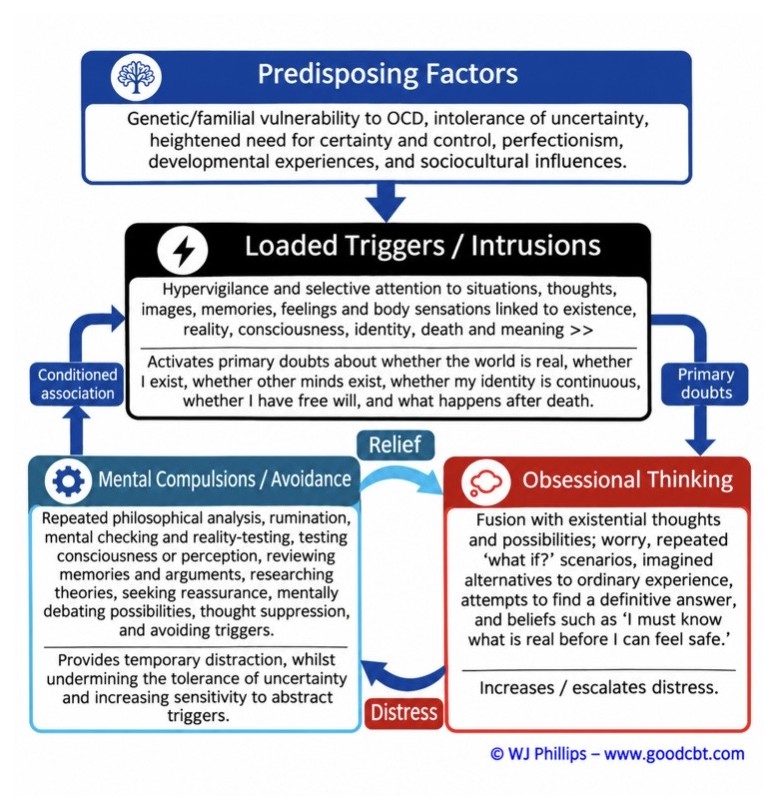
There is no single cause of Existential OCD. As with other forms of OCD, possible contributing factors include genetic and family vulnerability, sensitivity to threat, difficulty tolerating uncertainty, perfectionism and strong beliefs about the need for certainty and control.
Often when combined with a background or interest in philosophy, science, consciousness, psychology or the nature of reality, this can set the stage for the development of existential OCD.
Existential triggers can involve exposure to external concepts or ideas that are inherently uncertain, stressful life events that trigger questions about identity and purpose, near misses, accidents or personal bereavements, exposure to complex or abstract ideas when under pressure.
Common triggers include:
Whilst the triggers can be described as normal aspects of life, they can activate primary doubts that hypothetical questions are the same as real-life threats or consequences. This faulty reasoning problem, where insoluble philosophical questions, cross over into tangible threats or dangers, marks the beginning of the obsessional thinking process.
The primary doubts can lead to fusion with existential thoughts, feelings and out-of-body sensations, repeated philosophical analysis, worry, catastrophising and continuous self-searching or questioning. Typical preoccupations include:
The questions feel urgent, compelling and threatening, creating a strong need to investigate, check and find certainty. This inevitably leads to high levels of fear, feelings of desperation and anxiety.
As the questions and uncertainties become mentally overwhelming and emotionally distressing, the instinct is to search for immediate resolution, relief, escape, avoidance or reassurance. This can include:
Whilst these compulsive responses are attempts to reduce uncertainty and insecurity, they inadvertently increase attention on existential doubts and increase sensitivity to further existential triggers.
This creates a vicious cycle of brief relief followed by renewed uncertainty, further analysis and hypervigilance to existential questions.
The main evidence-based psychological treatments for OCD are Cognitive Behavioural Therapy (CBT), including Exposure and Response Prevention (ERP), Acceptance and Commitment Therapy (ACT), Inference Based Therapy (I-CBT) and Rational Emotive Behaviour Therapy (REBT).
For Existential OCD, ERP is adapted to address predominantly mental compulsions and philosophical forms of reassurance-seeking. This may include mental checking, repeated reality-testing, philosophical rumination, online research, reassurance-seeking and avoidance.
CBT helps identify the thoughts, interpretations and behaviours that keep the OCD cycle going. Adapted ERP involves gradually facing existential uncertainty while preventing the mental and behavioural responses that maintain the problem.
ERP may involve imaginal exposure, written exposure, deliberately allowing uncertainty to be present or continuing with an everyday activity while existential doubts remain unresolved.
The aim is not to find a final philosophical answer or prove that a feared possibility is false. It is to increase capacity to tolerate uncertainty and focus attention back to real-life goals and responsibilities.
I-CBT helps understand how irrational and obsessional doubts can develop from hypothetical possibilities through a process known as inferential confusion.
In Existential OCD, individuals become progressively absorbed in thoughts such as “What if everything is an illusion?” even though there is no rational evidence that ordinary experience is unreliable and the senses can no longer be trusted.
I-CBT helps distinguish between what is happening in the immediate experience and the imagined scenarios that create further doubt. It examines how a possibility can begin to feel like a reason to distrust ordinary experience.
The aim is to reduce the influence of obsessional reasoning, not to repeatedly test whether reality is real or seek further reassurance.
ACT uses a willingness to accept internal experiences, cognitive defusion, behavioural flexibility and committed action, to shift the focus from disproving internal existential fears, to acting in accordance with personal goals and values.
The aim is not to feel completely comfortable with uncertainty before acting. It is to develop the flexibility to act in line with personal values while difficult thoughts and feelings are present.
REBT helps identify rigid beliefs and demands that increase the need for certainty.
For example, beliefs such as “I must know that reality is real” or “I cannot tolerate not knowing whether I exist” can be examined and replaced with psychologically flexible alternatives.
The aim is to reduce the sense that certainty is essential and increase capacity to tolerate unanswered questions.
We may also draw on existential perspectives, including the philosophy of Jean-Paul Sartre, to help consider the relationship between existence, uncertainty and meaningful living.
Sartre’s idea that existence precedes essence offers one way of questioning the assumption that you must first understand or prove the nature of existence before you can live meaningfully.
The aim is not to prove philosophical ideas or establish the ultimate meaning of life. It is to recognise that unanswered questions do not have to stop one from making choices, developing relationships or engaging in meaningful activities.
A central therapeutic tenet in Existentially Informed CBT is:
“We do not need to establish absolute certainty about existence before we can choose to determine and participate in our own existence.”
A typical Existential OCD treatment plan may involve:
Mindfulness, attentional strategies and schema-focused interventions may also be useful, depending on individual needs and treatment goals.
Progress is measured by changes in distress, mental compulsions, avoidance and everyday functioning.
The aim of treatment is not to eliminate or resolve philosophical curiosity or answer every existential question. It is to break the compulsive cycle, increase uncertainty tolerance and shift focus back to an external sense of purpose and functioning.
The number of sessions depends on complexity, severity and duration of symptoms, however in our experience, the typical existential CBT treatment process involves between 12 and 20 sessions.
All clients receive a full assessment report, including a clinical formulation, relevant psychological factors and an outline of the proposed treatment plan.
Sessions are usually weekly, last 60 minutes and include therapeutic work, in-session practice and agreed exercises between sessions.
Your therapist will provide a written summary after each session, together with relevant therapy resources.
For more information, or to book an initial free introductory call, email info@goodcbt.com.
Book Appointment