
We provide evidence based therapy for Obsessive Compulsive Disorder, drawn from a number of well established and scientifically derived OCD treatment models. Engaging in effective therapy for OCD requires a sound understanding of the OCD model itself, in order to effectively target the underlying causes and psychological maintenance factors that keep the problem going.
This page therefore provides an introduction to the integrated model of OCD, covering the definition, conceptualisation and treatment of Obsessive Compulsive Disorder.
Each of the four areas covered in our OCD formulation are explained, together with an understanding of how background factors, triggers, doubts, obsessions, psychological distress and compulsions, maintain a vicious cycle of unhelpful behaviours and long-term suffering.
For more information about the practice based research behind the Integrated Model of OCD, email info@goodcbt.com
Before describing how the integrated Model of OCD works, it’s first important to briefly define Obsessive Compulsive Disorder itself.
Obsessive Compulsive Disorder (OCD) is a complex multifactorial problem involving unwanted and intrusive obsessional thoughts, irrational doubts, obsessional thinking, high levels of emotional and sensory distress and compulsive checking, neutralising and avoidance behaviours.
This maintains a highly dependent and habit-forming vicious cycle, in which short-term attempts to gain relief from the distress lead to long-term reinforcement of the problem.
The word “Obsession” itself is derived from the Latin “Obsidere” which means to besiege or occupy. In our clinical experience working with Obsessive Compulsive Disorder over many years, this term accurately describes the overwhelming and besieging feelings experienced by OCD sufferers.
Obsessions are defined as unwanted or intrusive thoughts, doubts, urges, feelings or images, which lead to significant anxiety, distress, discomfort, disgust, as well as other evaluative feelings including shame, guilt, embarrassment and insecurity.
More recently, another feeling of “Incompleteness” has been identified. This is an emotional sense that things are not “Just Right” or “just so,” leaving an unaddressed sense of disorder, indefiniteness, uncertainty or agitation.
The neurocognitive term “Yedasentience” has been used to describe the feeling that things are normally complete, achieved or safe enough to end the cycle of attention to an issue or problem. Research by Szechtman and Woody, shows how the yedasentience signal can be absent or reduced in the OCD brain, leading to the endless repetition of compulsive behaviours.
Compulsions are repetitive behaviours or routines that are performed in an attempt to avoid, neutralise, control or prevent the feared consequences of the obsession.
Whilst compulsions can become automatic over time, they are normally voluntary actions taken in response to the obsessional doubt or the associated distress.
Compulsions can be external behaviours sometimes referred to as “Overt” compulsions. These typically include physical acts such as touching objects, excessive cleaning, repetitive checking of switches or locks and organising items in a particular order or sequence.
Internal compulsions, sometimes referred to as “Covert” compulsions usually involve internal mental acts, rituals or routines. These can include repeating words or numbers, thought stopping or control, using words or phrases to neutralise or cancel out fears, excessive praying and repetitive memory checking.
For a clinical diagnosis of OCD to be present, the individual would normally experience obsessions and compulsions for at least one hour per day, leading to significant emotional distress.
In spite of these complexities and differences in obsessional and compulsive patterns, there are four common interconnected psychological processes that all forms of OCD follow. These common processes are illustrated in the integrated OCD Model and briefly outlined in the sections below.
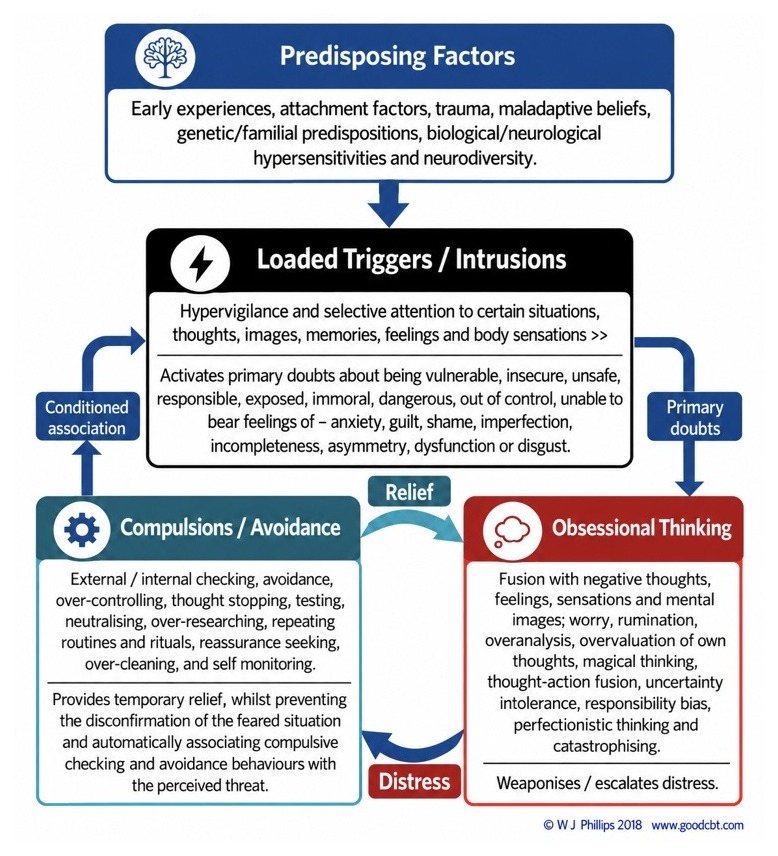
The above model draws on and integrates clinical and academic research conducted over the last 75 years, to present a coherent formulation of the common cognitive and behavioural factors that maintain Obsessive Compulsive Disorder.
The model integrates contributions from a number of evidence-based OCD approaches. These include:
Whilst each of the above evidence-based protocols have made distinct contributions to our understanding and treatment of OCD, they have also presented competing explanations of the processes implicated in the aetiology and maintenance of OCD itself.
Therapists following a single OCD protocol can therefore inadvertently omit, exclude or confuse these different approaches in an attempt to preserve brevity and treatment fidelity when working with their clients and patients. This can for example involve dropping cognitive strategies in pursuit of ERP, focusing on acceptance-based approaches over cognitive restructuring, tackling inferential confusion over metacognitive strategies or simply adopting a single solution approach in an attempt to minimise treatment complexity. The unintended consequence of this is that individuals struggling with OCD may receive suboptimal support, due to the limitations of following a condition specific formulation or therapy protocol.
Following the principles developed by David Barlow and colleagues, the integrated Model of OCD therefore incorporates these distinct contributions into a four-part cycle, providing flexible access to the best-in-class treatment options from these different CBT modalities.
Note: The following information provides a detailed understanding of the psychological processes behind the OCD model. It should however be noted that clients would not normally be expected to read and immediately understand these processes without the support and assistance of a properly qualified professional, fluent and experienced in the application of a range of cognitive and behavioural OCD models.
Whilst a number of different OCD presentations and subtypes have been identified, all forms of OCD follow the same basic psychological pattern. This is presented as a four-part model incorporating predisposing factors, triggers, intrusions and irrational doubts, obsessional thinking processes and compulsive / avoidance behaviours. The four parts of the integrated Model are outlined below:
Background factors are represented in the blue rectangle in the OCD Model. This illustrates how predisposing or historical influences can set the stage for the development of OCD.
Whilst OCD is primarily maintained by a number of faulty thinking patterns and compulsive / avoidance behaviours, research indicates that early life events, family context, trauma, insecure attachment experiences, early formed maladaptive schema, genetics, biological factors and neurological differences, can combine to set the stage for the development of OCD.
Identifying and addressing relevant background factors, in particular, unresolved traumas, core fears or maladaptive cognitive schema, may improve client insight and unlock deeply rooted psychological predispositions that could otherwise maintain a vulnerability to OCD.
Michael Greenberg has identified three core OCD-related fears, which can be helpful for understanding how the primary function of OCD is to avoid some form of emotional suffering. These include:
Addressing core fears and early background factors can improve client insight and agency as well as the efficacy and effectiveness of OCD treatment. This is particularly relevant where refractory or treatment resistant forms of OCD respond less effectively to established CBT strategies.
Care should always be taken to ensure that the exploration and adaptation of background factors addresses directly relevant, causal, unprocessed or unresolved fears, without detracting from the primary focus on obsessional and compulsive maintenance patterns that affect the individual in the here and now; Therapists must guard against using background factors as an inadvertent justification for further OCD introspection and over-analysis of the problem.
Relevant treatment interventions include: Schema informed strategies, identification of insecure attachment factors, elicitation of suffering related core fears, Trauma Focused Cognitive Therapy, Imagery Rescripting and cognitive restructuring of negative core beliefs, irrational rules and assumptions.
These approaches may be helpful strategies and adjuncts to the main therapy plan, where refractory OCD presentations persist.
This can be particularly helpful in perfectionistic, trauma-focused, disgust based and relationship focused OCD presentations.
This initial phase in the OCD cycle is represented in the black “Rectangle” and acknowledges that triggering situations are usually loaded with past associations and irrational doubts.
In this phase, hypervigilant scanning and selective attention to internal or external cues, cause normal doubts or hypothetical possibilities to be automatically interpreted as potential threats or dangers.
Triggers or OCD cues can include situations, events, images, memories, feelings and body sensations.
Over time and through the processes of operant learning, classical conditioning and inferential confusion, these normal triggers become synonymous with a conditioned association or “Primary Doubt”. E.g. -
In almost every instance, the individual fully understands the irrational and ego-dystonic nature of the OCD doubt. Over time however, the trigger becomes synonymous with the primary doubt which automatically leads to obsessional, intense, distorted and repetitive thinking patterns.
In this way, irrational doubts become escalated and weaponised to such an extent that they lead to intolerable levels of distress, including feelings of anxiety, overwhelm, incompleteness, shame and disgust.
Relevant treatment interventions include: Functional Analysis, attention / awareness training, pre-empting and calling out triggers, normalising intrusive thoughts, separating triggers and intrusive thoughts from consequential doubts, work on how inferential confusion contributes to the construction of irrational doubts and psychoeducation on how established compulsive patterns interact to turn neutral cues into negative associations and conditioned learning.
Whilst the psychological processes of operant and conditioned learning have long been acknowledged as behavioural factors in the development of OCD, research into a special form of cognitive therapy known as Inference Based Therapy (IBT), has more recently provided a cognitive alternative to traditional ERP based approaches.
IBT emphasises the importance of “Inferential Confusion”, in the development of irrational doubts, which directly lead to obsessional thinking, emotional distress and compulsive behaviours. IBT is relatively new in the field of OCD treatment and deserves its own brief footnote:
In addition to the behavioural effects of operant learning and classical conditioning, (covered in the second and third phases of our cycle), the “Primary Doubt” is established and strengthened through a psychological process known as “Inferential Confusion”.
This is an automatic cognitive process taking place at the initial phase of the cycle. It involves an abandonment of the evidence and an over investment in remote or imagined possibilities at the cost of the individual’s sensory experiences and common sense.
To understand how this works, we need to draw the distinction between external rational doubts and internal irrational doubts.
External rational doubts are normal uncertainties based on balanced and observable data. So, for example we might pause to consider our forgotten umbrella when dashing for a late meeting and noticing dark clouds in the sky. Do we go back for the umbrella which may cause further delays, or do we take the chance of turning up to our meeting wet through and dishevelled?
When we make healthy judgements or gambles about normal external and observable uncertainties, we refer to this as rational doubt.
On the flip side, irrational doubts involve automatically abandoning the evidence and established common sense in support of internally imagined possibilities.
Drawing on the clouds and umbrella metaphor, not only do we overestimate the chances of getting wet when the forecast is clear and dry, we might “magically” and tacitly associate the absence of our umbrella with the increased likelihood of rain.
In our OCD model, the “Primary Doubt” is always an irrational, internally synthesised doubt synonymous with a normal or ordinary trigger.
The problem is that this process becomes automatic and pervasive over time. It passes unnoticed or unchallenged from the first trigger phase into the second obsessional phase. It slips under the radar of conscious awareness into the obsessional phase of the OCD cycle, where it is inadvertently validated and reinforced through obsessional thinking and compulsive behaviour.
Once the “Primary Doubt” passes into the obsessional thinking phase, (represented by the red square in our model), it is subjected to over-evaluation, fixation, worry, distortion, amplification and misinterpretation. This weaponises and escalates the doubt and leads to significant emotional distress.
The metacognitive processes of thinking about thinking mean that the significance, importance and impact of thoughts are over-evaluated. OCD frequently involves worrying about the meaning of worry itself.
The process of “Cognitive Fusion”, which is a core psychological process in Acceptance and Commitment Therapy, is also a key driver of obsessional thinking in the red “Obsessional Thinking” stage of our model.
Fusion causes thoughts to become sticky and caught up in attention and emotional resistance. This increases the intensity and perceived seriousness or literal meaning of thoughts. Fusion translates and classifies thoughts as facts or realistic predictions, rather than loaded internal perceptions or judgements.
Research by the Obsessive Compulsive Cognitions Working Group (OCCWG), has also identified six OCD-related cognitive distortions that validate and supercharge the primary doubt.
These include the six domains of Over-evaluation of thoughts, including Thought Action Fusion, over-estimation of threats, including catastrophising, Inflated Responsibility, Intolerance of Uncertainty, Controlling Thoughts and Perfectionistic Thinking.
These thinking habits or distortions compound and exaggerate the worry and self-questioning, leading to high levels of anxiety, shame, guilt, embarrassment and disgust.
Relevant treatment interventions include: work on the processes of obsessional thinking, rumination and worry, rather than attempting to stop or eliminate intrusive thoughts and doubts. This includes metacognitive approaches, cognitive defusion and acceptance techniques, identifying and altering / unhooking from OCD-related cognitive distortions, cognitive restructuring where necessary, embracing uncertainty using cognitive and behavioural experiments, exposure and mindfulness-based approaches.
OCD obsessions directly activate compulsive and avoidance behaviours in an attempt to evade, escape or gain relief from the obsessional distress.
(Note: OCD distress is not limited to anxiety and the Limbic system’s fight, flight and freeze response; Neurological research has identified dysregulation of the Cortico-Striatal >> Thalamo-Cortical - CSTC circuit in OCD. This means that feelings including disgust and perfectionistic incompleteness also arise from obsessional doubts. Where the feelings are based on a disgust or intolerance of imperfection, mastery-based approaches are indicated over standard ERP strategies).
Repetitive checking, avoidance, neutralising, escape, high-control and ritualistic behaviours are commonly referred to as compulsions in OCD. In our model, compulsions are represented in the “green square”.
Compulsions can be external or “Overt”, such as checking locks and switches, excessive cleaning, repeating and comparing.
Internal or “Covert” compulsions can involve mental acts, rituals or routines such as thought neutralising, memory checking, the use of “cancelling” or “magic” words, body scanning and sensory checking. Rumination may also be compulsive, where the function of this behaviour is to check, test or resolve doubts and obsessional worry.
Whilst compulsions create a temporary sense of relief, outlined in the following section on Operant and Conditioned learning, they also lead to significant functional impairment.
OCD compulsions and avoidance behaviours progressively interfere with the conduct of normal daily life and consume significant amounts of time and energy. The relentlessness of compulsions causes problems at work, at home and in key personal relationships.
Relevant treatment interventions include: in vivo and in vitro forms of ERP, paradoxical spiking, provocation strategies and acting opposite, to encourage extinction, habituation and inhibitory learning. Third-wave approaches can also incorporate ERP+, which is a values and mastery-based approach to “Exposure Relevant to Purpose”. This is particularly relevant to perfectionistic and disgust-based forms of OCD.
OCD is reinforced by two important psychological processes known as Operant and Conditioned learning. These processes create invisible psychological forces that maintain and validate the OCD cycle.
In our model, Operant Learning is represented by the red and green arrows labelled “Distress” and “Relief”.
Operant Learning is negatively reinforced, as performing compulsions leads to the alleviation of distress through short-term or temporary relief.
Obsessional doubts may, for example, lead to feelings of anxiety, disgust or uncertainty about germs or security. This distress is relieved through cleaning and checking behaviours, which provides a temporary proxy for safety and control.
Operant learning leads to ingrained and addictive compulsions by providing the illusion of contingent or real-time relief from the obsessional doubt and worry.
Of course, the relief is not real or curative relief, it is a proxy or temporary form of relief. This also inadvertently prevents the disconfirmation of the obsessional doubt and reinforces the automatic association between the need to perform the compulsion and the loaded trigger.
This association is a process known as “Conditioned Association”, in which the compulsion and the trigger become automatically and tacitly associated.
Examples of conditioned associations include automatically taking pictures of the lock becomes synonymous with leaving the house, using sanitiser becomes synonymous with touching handles and automatically scanning for feelings of arousal becomes synonymous with seeing a vulnerable person.
This association between the compulsion and the trigger eventually becomes so intertwined, that individuals often report an awareness of the compulsion, without consciously acknowledging the triggering event or situation.
This process of association also reinforces the primary doubt implied by the compulsion, which in turn maintains the vicious OCD cycle.
In this way, OCD can be viewed as a four-part cycle, reinforced through a number of faulty thinking processes and habitual behavioural patterns. The problem is that for every increment of short-term relief or certainty gained through the compulsion, OCD trades an increment of long-term reinforcement. This trade-off between relief and reinforcement leads to chronic psychological symptoms.
The purpose of cognitive and behavioural psychotherapy is to learn new thinking and behavioural techniques to break the OCD cycle and establish healthy and adaptive coping strategies. These strategies include cognitive reappraisal of faulty thinking, learning how to identify and unhook from obsessions, graded exposure to feared situations and a process known as “Inhibitory Learning”.
These strategies are covered under the section on Cognitive and Behavioural treatment.
The first step in this process and the purpose of this material is to understand how OCD is maintained in order to learn how to disrupt, break and replace the OCD cycle.
Book Appointment