
We provide specialist Cognitive Behavioural Therapy for Paedophilia OCD, also known as POCD and normally categorised alongside other unwanted sexual obsessions.
POCD is not recognised as a separate OCD diagnostic subtype and is normally viewed alongside similar OCD obsessions including sexual identity, inappropriate sexual acts, sexual violence or harm. The common denominator is that the intrusive thoughts, doubts and obsessions are all fearful and repugnant to the sufferer.
POCD is profoundly opposite to and completely unrelated to Paedophilic Disorder. Far from involving inappropriate feelings of attraction, POCD actually causes extreme levels of emotional distress, increased hypervigilance and patterns of social isolation, avoidance and withdrawal.
If you are struggling with POCD or other unwanted or distressing sexual obsessions, we can help. Our therapeutic approach combines a number of evidence-based specialist CBT models developed specifically to address these problems.
To talk confidentially to a qualified specialist, email info@goodcbt.com or complete our contact form to organise a call back.
Paedophilia Obsessive Compulsive Disorder (POCD) is a form of OCD involving intrusive and personally repugnant thoughts, images, doubts and extreme fears of being sexually attracted or dangerous to children.
The intrusive thoughts, doubts and obsessions lead to intense feelings of anxiety, guilt and shame. This causes sufferers to become socially withdrawn and often isolated from children, family and friends.
The critical and paradoxical issue with POCD is that the content of the unwanted intrusive thought is not evidence of sexual attraction, intention or risk to children. In fact it is precisely the opposite and represents an over-developed sensitivity to possible threat or danger.
This is because the OCD brain is hypervigilant and continuously scanning for unwanted or upsetting thoughts and images. This inadvertently increases attention to the same unwanted thoughts and images. The presence of the unwanted thoughts and images is then automatically misinterpreted as potential evidence of risk or intention.
The intrusive thoughts, images and doubts actually relate to deeply distressing or personally repugnant subjects without representing what the individual wants to happen. Similarly, anxiety, guilt, shame or ambiguous bodily sensations are caused in reaction or opposition to the intrusions, rather than reflecting sexual intentions or danger.
POCD can be understood as a vicious cycle in which triggers or intrusive thoughts activate irrational doubts, the irrational doubts fuel obsessional thinking and the compulsions provide temporary relief, whilst inadvertently reinforcing the original fears.
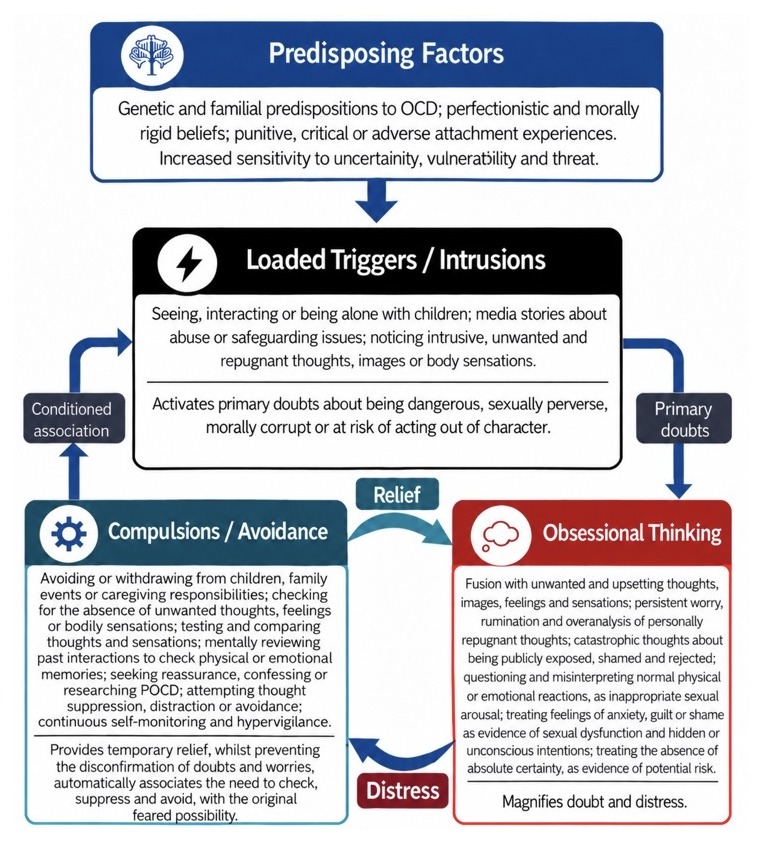
There is no current research that specifically links background or biological factors to POCD. Indeed the evidence actually shows that unlike paedophilic disorder, sexual abuse and sexual trauma are not causally linked to POCD.
Potential predisposing factors for sexual, harm and moral obsessions can however include genetic and familial susceptibility to OCD, heightened sensitivity to threat or vulnerability, rigid beliefs about morality and responsibility and an intolerance of uncertainty.
Sexual and harm obsessions can also involve early-life experiences, including adversity or punitive parental relationships, performative and disorganised attachment experiences and exposure to high levels of childhood criticism and shaming.
These factors may influence how intrusive experiences are interpreted, but their specific causal roles in POCD remain insufficiently established.
No single background factor is necessary or sufficient for developing POCD. The subject matter of an obsession does not establish its cause or reveal a person's underlying desires or intentions.
Research supports genetic and familial contributions to OCD generally, whilst specific evidence for POCD remains limited.
This helps to illustrate that POCD is caused by an increased sensitivity to fear, uncertainty intolerance and avoidance, rather than specific sexual content.
There can be a range of external and internal triggers. These include seeing, interacting or being alone with children, encountering media stories about abuse or safeguarding, or experiencing unexpected thoughts, memories or bodily sensations.
Triggers can activate fears or doubts such as: "What if I am dangerous?" "What if this thought means something about me?" "What if, deep down, I am sexually deviant or could act out of character?"
These doubts can transform ordinary experiences into perceived threats to identity, morality or safety.
OCD doubts lead to repetitive worry, rumination and over-analysis of the unwanted thoughts, images, feelings and sensations. This involves imagined catastrophic outcomes including being publicly shamed, rejected by friends and family and social isolation.
In an upside down way, anxiety, guilt and shame are frequently misinterpreted as evidence of a feared possibility. Attempts to achieve absolute certainty or trying to outthink or disprove the obsessions serve to magnify the OCD doubts and distress further.
In response to the obsessional worry and distress, a person may avoid children or family situations, mentally review interactions, repeatedly check thoughts or bodily sensations, compare reactions, seek reassurance or confess, research POCD on the internet or in forums, attempt to suppress thoughts and continuously monitor feelings and physiological reactions.
Whilst the compulsive behaviours are undertaken in a desperate attempt to eliminate or disprove the doubts and exclude any element of uncertainty, they increase attention and hypervigilance to the triggers.
This creates a trade-off between short-term relief and long-term reinforcement; the checking and avoidance behaviours provide some transient relief from fears, whilst inadvertently preventing the disconfirmation of the feared situation and an automatic association between the need to self-monitor and the original trigger.
Without psychological support and exposure to the feared situation, this vicious cycle becomes ingrained, highly distressing and isolating.
The principal evidence-based psychological treatment for POCD is an adapted form of Cognitive Behavioural Therapy. CBT also incorporates Exposure and Response Prevention (ERP).
These approaches are relevant to POCD because they address the obsessional and compulsive cycles rather than attempting to prove or disprove the content of individual thoughts.
Structured exposure is a key component of the therapy process and involves gradually confronting feared thoughts and situations, without engaging compulsive or avoidance behaviours.
For someone experiencing POCD, this may involve learning to tolerate uncertainty without repeatedly checking feelings, reviewing memories, seeking reassurance or avoiding everyday situations solely to neutralise obsessional anxiety.
CBT may also incorporate cognitive strategies to address catastrophic interpretations, inflated responsibility and the perceived need for absolute certainty. Acceptance and Commitment Therapy (ACT) techniques may help people respond differently to intrusive experiences without becoming entangled in attempts to control or eliminate them.
Inference-Based CBT (I-CBT) is incorporated into the therapy process to help clients draw a clearer distinction between the internal thinking processes through which the POCD doubts first arise.
A typical therapy plan may involve the following steps:
It may also be helpful to integrate mindfulness, focus of attention and schema strategies to augment the above treatment plan, depending on the client's presentation, time and priorities.
Progress is generally evaluated through changes in obsessional distress, compulsive behaviours, avoidance and day-to-day functioning, rather than through achieving absolute certainty about intrusive thoughts.
The aim of treatment is not to eliminate every unwanted thought or prove what a thought means. It is to change the cognitive relationship with intrusive experiences and break the compulsive cycle that keeps POCD going.
The number of sessions depends on symptom severity, duration, functional impact, coexisting conditions and the person's response to treatment.
In our experience, approximately 8 to 20 sessions is a useful initial guide and this is confirmed in our assessment report following the first appointment.
All clients receive a full assessment report covering a clinical diagnosis where relevant, a summary of the psychological maintenance factors and an outline of the proposed therapy plan.
Thereafter, sessions are normally organised on a weekly basis, last for 60 minutes, include techniques and in-session practice and agreed assignments.
Weekly sessions are supported by a written summary provided by the therapist together with any relevant therapy resources.
For more information, or to book an initial free intro call, email info@goodcbt.com